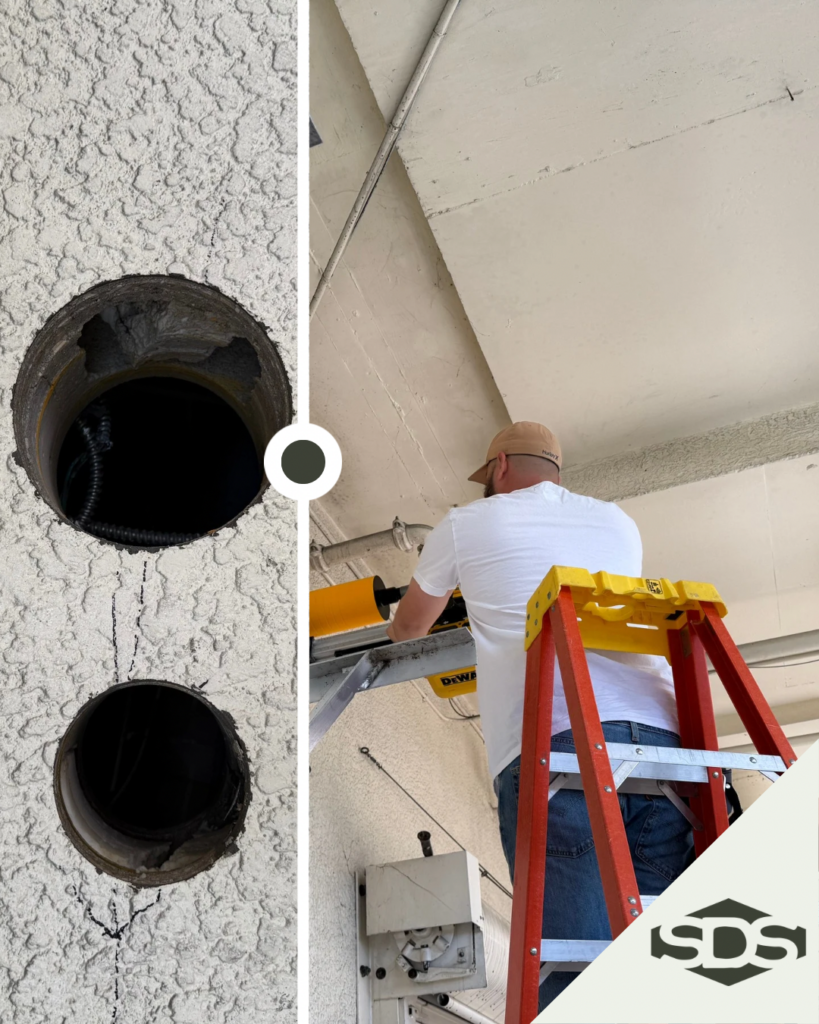
Core drilling is a precise, low-impact method used in construction to create clean, circular holes through hard materials like concrete, masonry, asphalt, and stone. Using a rotary drill fitted with a diamond-tipped core bit, the process removes a solid cylindrical “core” while leaving the surrounding structure intact. This technique is critical in a wide range of applications—from new builds to structural retrofits—and is especially valuable in regions like Florida, where unique environmental, regulatory, and structural demands are in play.
Why Core Drilling Matters
Core drilling supports many core functions in the construction industry. One of the most common uses is to provide access for mechanical, electrical, and plumbing (MEP) systems. Whether it’s routing conduits through concrete slabs or creating openings for HVAC and fire protection services, core drilling ensures that these penetrations are precise, clean, and safe—minimising disruption in both new and occupied buildings.
It’s also commonly used for extracting structural samples for testing. Engineers rely on core samples to assess the compressive strength, density, and material composition of concrete, particularly when verifying code compliance or investigating potential defects. This makes it a critical part of both quality assurance and long-term maintenance strategies.
Refurbishment and retrofitting projects benefit heavily from core drilling. Rather than demolishing large sections of walls or floors, contractors can use this method to install new systems, anchoring points, or fixings with minimal disturbance. It also plays a key role in the installation of fasteners, dowels, and steelwork, where accuracy is non-negotiable for load-bearing elements.
In environmental and infrastructure projects, core drilling enables the extraction of subsurface soil or rock samples. These are often used in geotechnical studies, foundation design, and environmental assessments—making the process just as important underground as it is above.
Why It’s Especially Important in Florida
Florida’s construction landscape presents a unique set of challenges that make core drilling not just helpful, but often essential.
Hurricane-Resistant Infrastructure
Due to the frequency of hurricanes and tropical storms, Florida enforces some of the strictest building codes in the U.S. Structures must be able to withstand extreme wind loads and water intrusion. Core drilling plays a vital role in this by allowing for the precise installation of hurricane ties, anchor bolts, and retrofitted reinforcements in concrete and masonry walls.
High Water Tables and Variable Soils
Florida’s high water table and sandy or limestone-rich soils require careful subsurface analysis before any deep foundations or underground utilities can be installed. Core drilling allows engineers to retrieve accurate core samples that help determine the load-bearing capacity and drainage characteristics of the soil—vital for foundation stability.
Urban Density and Occupied Buildings
In cities like Miami, Tampa, and Orlando, many projects are built within or adjacent to occupied buildings. Core drilling’s low-vibration, low-noise performance makes it ideal for creating utility pathways or anchor points without disrupting ongoing business operations, healthcare services, or residential life.
Retrofitting Aging Structures
Much of Florida’s built environment—particularly along the coast—consists of older concrete buildings. Many of these require upgrades to meet current safety, energy, or environmental standards. Core drilling is often used to create access points for new systems, reinforce existing structures, or extract samples for structural recertification processes like the mandatory 40-year building recertification in Miami-Dade and Broward counties.
Marine and Coastal Projects
Florida’s coastal zones and wetland areas often call for environmental monitoring or marine infrastructure such as docks and seawalls. Core drilling supports these efforts by enabling low-impact drilling into reinforced concrete and shoreline rock formations, providing access for pile anchoring, sampling, and installations in environmentally sensitive areas.
A Low-Impact, High-Precision Solution
Perhaps the most valuable trait of core drilling is how clean and non-invasive it is. It generates minimal vibration, noise, and dust, making it safe and practical for use in hospitals, schools, offices, and residential settings. It also reduces the risk of micro-cracking or compromising structural integrity—particularly important in older or load-bearing concrete.
Conclusion
Core drilling is far more than just a method for cutting holes—it’s a precision solution that supports everything from safety compliance to service integration and environmental assessment. In Florida, where extreme weather, complex soil conditions, and strict regulations shape every phase of construction, core drilling is an indispensable part of delivering safe, durable, and code-compliant structures. Whether you’re building new, renovating old, or preparing a site for future development, it’s a process that brings confidence, accuracy, and efficiency to the job.